History Co-Author Review: Can AI Really Help You Write A Narrative History Book Worth Publishing?
Affiliate disclosure: This post contains affiliate links. If you buy through them, I may earn a commission at no extra cost to you. Please read the whole review and decide for yourself.
If you have ever wanted to write a book about a war, a king or an era you love, you have probably hit the same two walls. The research looks like a mountain. And every time you ask an AI for help, you get back either something that sounds confident but cannot be trusted, or something so flat it reads like an encyclopedia entry.
History Co-Author says it solves both. In this History Co-Author review, we’ll examine what is included, what the creator’s own results look like, where the system falls short, and who should consider skipping it.
History Co-Author says it solves both. This review covers what is actually inside, what the creator’s own results look like, where it falls short, and who should skip it.



The short version
What History Co-Author actually is
This is not a prompt pack. It is a research and writing framework made of three files:
The Narrative History Framework. The genre architecture. It covers what Soren calls the engine of consequence, three dials (pace, scale and narrator), the record rules that keep every quotation exact, and nine narrator voices. By his account it took four months to build and test.
The Style Pack. The publishability layer. Banned-word and banned-phrase lists, cliche bans, anti-AI-tell rules, and a self-diagnostic you run on your own output.
The Setup Prompt. An 18-step guided planning conversation with three research moments built in. At every step you get options with reasoning. This is what turns Claude or ChatGPT into your co-researcher and co-author.
There is also Narrative History Studio, included with the system. It is two plugins, one for Claude Cowork and one for ChatGPT Work, that create your book’s folders, run Setup, start each chapter and run the closeout for you. No copying files and no pasting prompts. If you prefer to work by hand, the three files also work in any Claude or ChatGPT project.
And there is a 29-module training course covering the steps between your first idea and a published book: finding sources, story planning, editing, formatting in Kindle Create, covers, KDP publishing, description and keywords, free promotion methods and building a series. It includes click-through screenshot tutorials, video walkthroughs, action steps and a discussion thread in each module.
As part of this History Co-Author review, it’s worth noting that the offer combines the writing framework with a publishing education component. That makes it broader than a standalone AI writing prompt.
How it works: Plan, Write, Publish
Plan. You drop the three files into a project and answer 18 questions about the book you want. Before each of its three research moments, the AI asks you first, then goes to the sources and builds a research record. It takes about a couple of hours, and you end up with five planning documents, including a Research Bible that holds every source.
Write. The AI writes with you, chapter by chapter, in one consistent voice. The framework holds the voice and the prose discipline, the Research Bible holds the facts, and a running Book State keeps continuity from chapter to chapter.
Publish. You say “close out the book” and it builds a cast of characters, a note on names, a note on sources, chapter notes and a selected bibliography, as separate files for Kindle Create. The course then walks you through the rest.
The part that matters most: accuracy
History readers are the one audience that checks, so this is where I looked hardest.
According to the framework’s rules, every quotation is copied word for word from its source and checked against it again after every chapter. Every figure comes from the Research Bible. It does not invent quotes, events, or the thoughts of a named person. Where the record is silent, it writes around the gap or tells the reader the record is silent.
It also shows its work. In the back of Book 1 of Soren’s own series, A Note on Sources says of a famous tradition: “The evidence does not settle who commanded.” Where he leaned on another historian’s citation, the chapter notes say so.
To be clear, this is not a promise of zero errors. No history book manages that, and you still read your draft like any author would. But a system built around “show the source or say nothing” is a very different starting point from a cold prompt.
You can also hand it your own sources, such as letters, diaries and records from free archives like the Library of Congress, the Internet Archive and Project Gutenberg, and it reads those first.
For anyone reading this History Co-Author review because they are concerned about historical accuracy, this source-focused approach is one of the most important features to investigate.

Does it read like a book or like Wikipedia?
This was Soren’s own struggle. One month before release, he came close to shelving the whole product. The research worked from the start. The writing kept coming back correct, careful and dead, like a Wikipedia article. He held the product back until it read like a story you cannot put down. I respect that, because plenty of products ship at the first version that technically works.
The sales page shows the difference side by side with the same event, the burning of the Miami towns in 1790. The system’s version uses the general’s own report and his own count: three hundred houses and twenty thousand bushels of corn. The plain-prompt version never opened the report, so it had nothing to count. It hedges, gives no person you can see, and ends on a lesson.
That is the best summary of the category difference I have come across. Generic AI history is not usually false. It is just empty.
The showcase books use a spare, stoic voice that Soren chose. You pick your own from nine narrator voices, or blend two, and you hear a sample before a single chapter is written.
One reason to consider History Co-Author review findings carefully is that the quality of the final writing matters just as much as the ability to generate text. A book needs evidence, structure and an engaging reading experience.
The proof: Forgotten Wars of American Expansion
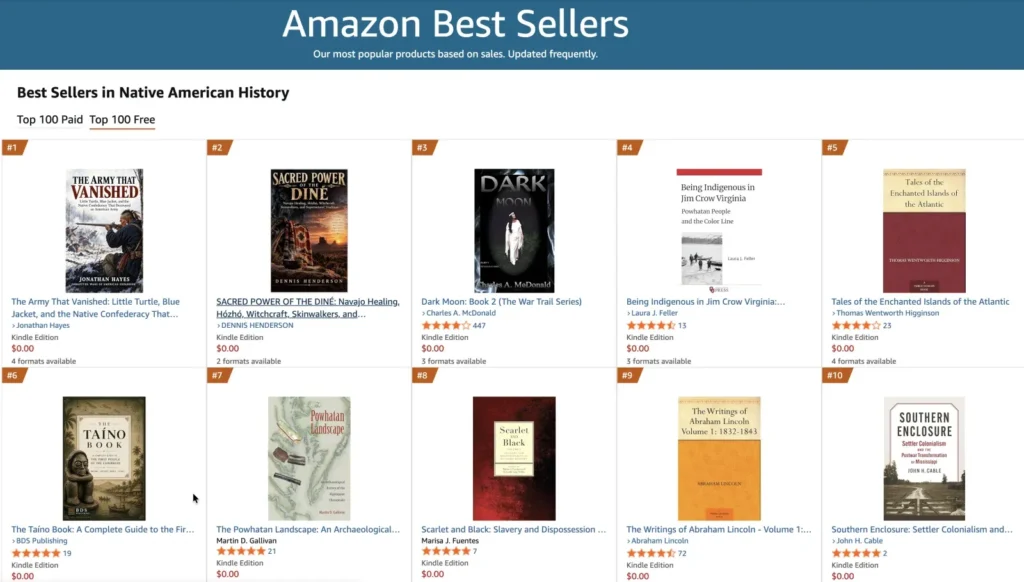
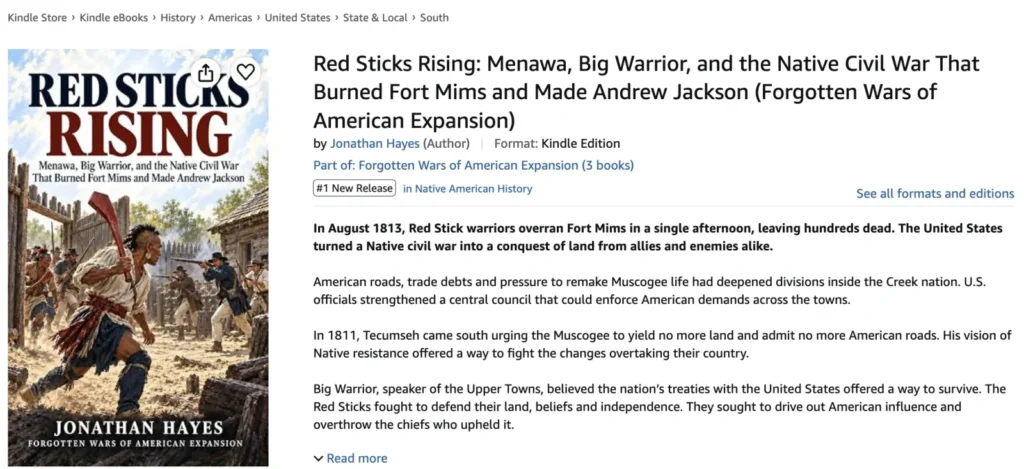
Soren used the system to research, write and publish a three-book series under the pen name Jonathan Hayes. The books are The Army That Vanished, Red Sticks Rising and War in the Swamps, and all three are live on Amazon. The figures below are as of late September 2026.
- All three books were researched, written and published in under fourteen days, together, not each.
- During a free promotion, Book 1 hit #1 on Amazon’s History list, #1 in Native American History, and #53 in the entire Kindle Store free list. Those are free-chart rankings, so read them as reach, not sales.
- Readers then bought Books 2 and 3 at full price. Red Sticks Rising took Amazon’s #1 New Release badge in Native American History and reached #5 paid in History of Southern U.S., three places below Midnight in the Garden of Good and Evil. Books 2 and 3 also sat side by side in the Native American History top 20.
- The day after upload, before anyone had been told the book existed, a reader searched Amazon for the subject and bought Book 2.
- In September, the two paid history books were the top earners in his whole KDP account, ahead of a cozy fantasy series that had been selling since spring.
- The paperbacks are also stocked at Walmart.com.
- A verified five-star Amazon review reads: “I learned quite a bit that was never taught in history class.”
On the money side, his numbers are modest and he presents them that way. Across nine books in three genres, January to late September 2026, he reports 190,947 Kindle Unlimited pages read, $858.08 paid for those pages, and $1,774.92 in total royalties on Amazon.com alone. That is across the whole account, not only the history books.
One more detail I appreciated: he gave Google’s Gemini the full book blind and asked whether AI wrote it. Gemini did spot the AI. It then added that “the average commercial reader will not know, nor will they suspect it.” Both halves are on the page, which is more honesty than I usually see.
For this History Co-Author review, the three-book case study provides useful context, but it should not be interpreted as a promise of fast publishing or predictable income.
Why a series, and why this shelf
The business logic is simple. Kindle Unlimited pays per page read, not per sale. History readers tend to finish one book and go looking for the next on the same subject. Each book in a history series is a complete true story, so a reader can start anywhere.
The shelf itself is held mostly by big publishers, journalists and academics, with very few independents. According to YouGov, 30% of Americans who read a book in 2025 read history. That is a big audience with little indie competition, though it is still your job to find those readers.
What it costs to run
I am not going to quote a price here, because pages change. Check the current offer page for pricing and the 14-day money-back guarantee.
What I can tell you is that the system needs Claude or ChatGPT, which is about twenty dollars a month for either one. You only need one, and many serious publishers already pay for one. Publishing on KDP is free, the promotion methods taught are free, and covers can be made with free AI tools. So it is not free to run, but it is cheap to start.
What I liked
- It starts from the sources. The Research Bible and the “show the source or say nothing” rule address the real fear with AI history.
- The side-by-side example is honest. It shows the weak version as well as the strong one.
- You stay in control. You choose the options at every step, the narrator voice and what stays or goes.
- It shows its work in the back of the book. Source notes, chapter notes and a bibliography are built for you, including the places where the evidence does not settle a question.
- The training is the finish line. Writing is one step. Formatting, covers, KDP settings and promotion are the ten that follow, and the course covers them.
- The proof is checkable. The books are on Amazon under Jonathan Hayes, so you can look for yourself.
- Updates are included. Soren improves the system over time, and buyers get the updates.
These strengths make the product worth investigating for authors who want a structured workflow. They are also central to my assessment in this History Co-Author review.
What could be better
- Narrative history only. Biography, battles, ancient history and other history genres are separate products.
- You need a paid Claude or ChatGPT plan. It is cheap, but it is not nothing.
- It is not one-click. You still edit, format and publish yourself.
- 29 modules is a lot. If you just want to start writing, the course can feel like homework. You can skip around, but you will want to know where to jump.
- Thin sources mean a harder book. It will not invent what the record does not hold. If the sources on your subject are thin, the book says so rather than filling the gap. That is honest, but it can make some subjects harder.
- Results depend on you. Publishing and promoting the book is your job. Soren’s results are his, not a forecast of yours.
A fair History Co-Author review needs to consider these limitations alongside the benefits. The product is best understood as a structured writing and publishing system, not an automatic book business.
Who this is for
- History lovers who have always wanted to write a book but are not writers or historians
- People who skipped AI fiction products because fiction was never their thing
- KDP publishers looking for an under-served shelf
- Owners of Soren’s fiction Co-Authors who want to add nonfiction
- People who bought AI writing products before but never finished and published
- Anyone who cares about accuracy and wants real sources at the back of the book
Who this is NOT for
- Anyone expecting instant riches. It is a publishing model, not a lottery ticket.
- People who will not do the work of editing, formatting and publishing
- People who want historical fiction, invented characters or made-up dialogue for real people. This system sticks to the record.
- People who want a hands-off, one-click process. It is a co-authoring tool, so you make the calls.
- People opposed to AI-assisted writing on principle
How it compares
Compared with a cold prompt in a chat window, this is a different category. A plain prompt writes from memory, while this works from a research record and a set of rules about quotes and voice. Compared with “write a book in a weekend” products, it is slower and asks more of you, but it is aiming at a book you can put your name on. And compared with traditional narrative history, which can take years of research and writing, it compresses the grind into days, though not the thinking.
My verdict
If you want a trustworthy way to turn a subject you love into a sourced, readable history book, and you are willing to edit and publish it yourself, History Co-Author is worth a serious look. The accuracy rules, the side-by-side proof and the full training make it a real system rather than a clever prompt.
My verdict in this History Co-Author review is that the product appears most relevant to aspiring narrative history authors who value structure, research discipline and practical publishing guidance.
If you are looking for a shortcut or a guaranteed income, skip it. It will not give you either, and Soren does not claim it will.
My recommendation: read the full sales page, watch the demo, and use the 14-day guarantee as your safety net.
Home | Terms | Privacy | Disclosure | Commission Disclaimer | |Earning Disclosure & Legal Statement | Contact |
Affiliate Disclosure: This article may contain affiliate links. Trinity Digitech may earn a commission from qualifying purchases or sign-ups at no additional cost to you. We aim to provide honest, useful information to help you make informed decisions. Product features, pricing, terms, and results may vary. Please review the provider’s official terms before purchasing.
©Copyright 2026 Trinity Digitech